
Table of Contents
- What Makes a Political T-Shirt Effective
- Top Shirts for Political Expression in 2026
- Political Campaign Merchandise Ideas for Events
- Polling Place Clothing Restrictions You Should Know
- Workplace Dress Code Policies for Political Apparel
- Design Principles and Visual Communication
- Quality, Fabric, and Long-Term Care
- Frequently Asked Questions
Last Updated: September 3, 2026
What Makes a Political T-Shirt Effective
A political t-shirt succeeds when it communicates a message clearly while maintaining quality and durability, designed to spark conversation, not fade after three washes.
Effective political apparel balances legible design, durable fabric, and resonant messaging. The design must land immediately, people should understand your statement within seconds, not squint to read fine print.
Historically accurate designs perform well because they reference real place names, historical events, and cultural moments, creating connection with people who recognize them. Humor and irony also drive engagement, especially meme-style designs among younger demographics.
Quality matters for activist apparel because you'll wear it repeatedly. A shirt that holds color and shape through dozens of washes becomes part of your identity; one that cracks and fades after five wears undermines your message.
Top Shirts for Political Expression in 2026
The market for political apparel now offers historically accurate designs, artist-driven parody work, sustainable activist wear, and custom print-on-demand solutions. Here's what's worth your money.
Historically Accurate Design Options
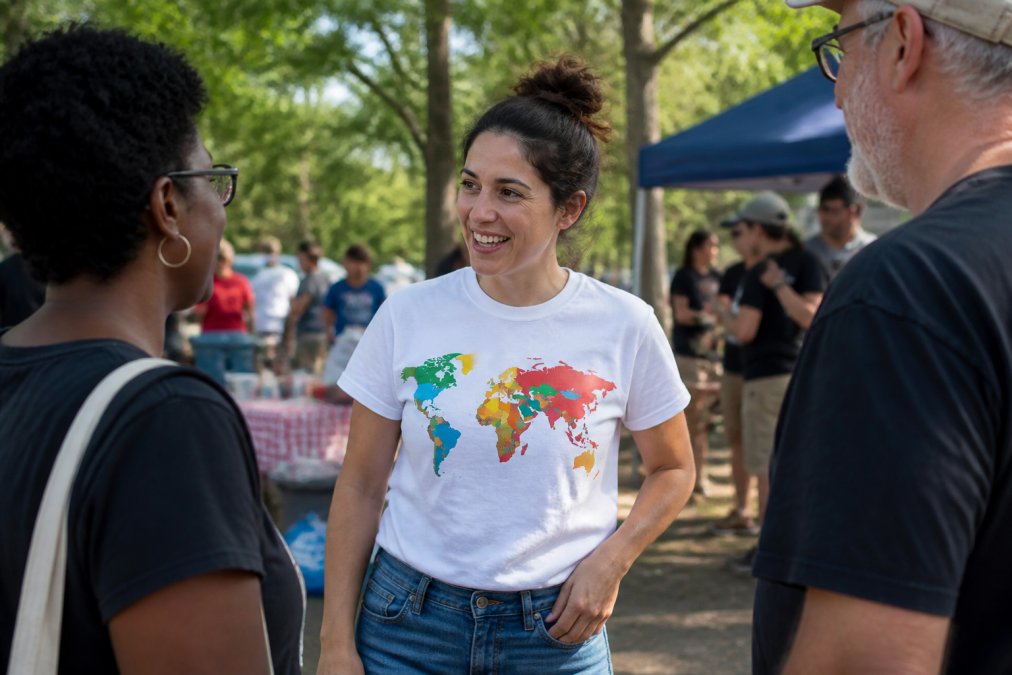
Historically accurate designs reference real place names, historical events, and cultural moments. They're factually grounded, giving them credibility and depth.
Correct Geography specializes in historically accurate designs, featuring original names and references restored to factual accuracy. This appeals to people who value authenticity and substance beyond surface-level slogans.
Etsy sellers also offer vintage-style and historically inspired designs, often handmade or small-batch produced, at higher prices but with direct support to independent creators.
Organic and Sustainable Activist Gear
Wear No Crown focuses on organic materials and thoughtful design, positioning apparel as both politically meaningful and ecologically responsible.
Sustainable gear appeals to people who view consumption as an extension of values. Organic cotton, natural dyes, and ethical manufacturing align wardrobe with politics.
The tradeoff is price. Sustainable options typically cost more than conventional alternatives. However, the durability and environmental benefit justify the investment for many buyers.
Custom Print-on-Demand Solutions
Print-on-demand platforms like Printful offer flexibility for campaign merchandise without inventory or bulk order commitments.
This works well for campaign teams and event organizers needing quick merchandise. No minimum orders allow design testing, and integration with Shopify and Etsy simplifies launching merchandise lines.
The downside: you're responsible for design work, and quality depends on the print provider. Print-on-demand shirts typically don't match the durability of higher-end alternatives.
Artist-Driven and Parody Designs
TeePublic hosts user-generated political designs spanning every ideology, from partisan commentary to feminist messaging to absurdist humor.
Artists create layered, ironic commentary appealing to specific communities. The tradeoff is quality variability, as different print providers handle orders.
Political Campaign Merchandise Ideas for Events
Campaign merchandise generates revenue, builds community identity, and extends your message beyond the event. Wearers become walking advertisements for your cause.
Effective strategies include bulk ordering with volume discounts, limited-edition designs tied to specific moments, prioritizing quality over quantity, and offering variety in sizing and fit.
Polling Place Clothing Restrictions You Should Know
Political expression at polling places operates under specific legal constraints that vary by state.
Federal law prohibits certain political expression inside polling places and within buffer zones. Most states restrict clothing displaying candidate names, party affiliations, or campaign slogans within 100 feet of polling locations.
Polling places must remain neutral spaces where voters decide free from immediate campaigning.
What's typically allowed: generic political messaging, historical references, or statements about issues (rather than specific candidates). A shirt referencing voting rights, democracy, or civic participation generally passes. A shirt with a candidate's name or explicit endorsement does not.
Check your state's specific rules before voting. Election officials can turn you away or require you to cover political apparel that violates local restrictions.
Workplace Dress Code Policies for Political Apparel
Workplace policies on political expression vary widely. Many employers maintain viewpoint-neutral policies restricting all political messaging regardless of ideology.
Common restrictions include: complete prohibition on all political apparel; stricter rules for client-facing employees; event-specific allowances (especially election day); context-dependent enforcement; and candidate vs. issue distinctions.
Under Title VII, employers can restrict political expression if viewpoint-neutral and applied consistently (eeoc.gov). However, some state and local laws offer stronger protections, California Labor Code Section 1102, for example, protects political activity rights (dir.ca.gov).
Most employers apply "viewpoint neutrality", banning all political messages equally. This holds up legally but enforcement is often inconsistent.
Real-world scenarios: Election day exceptions allow political apparel as civic participation. Nonprofits with advocacy missions are more permissive. Client-sensitive industries (law, finance, government, healthcare) enforce stricter policies. Creative fields tend to be more permissive.
If an employer tells you to remove a political shirt, ask for the specific policy citation and request written clarification. Document the interaction. If enforcement appears discriminatory, consult an employment attorney. Review your employee handbook or ask HR before wearing political apparel to work.
Design Principles and Visual Communication
Effective political t-shirt design maximizes impact and readability. Color psychology separates shirts that spark conversation from those that fade into the background.
High-contrast color combinations read clearly from several feet away. Test designs at arm's length on a phone screen; if you can't read it easily, it won't work on a moving person.
The most important element should be largest and most prominent. Weak hierarchy dilutes your message and wastes shirt real estate.
Colors trigger specific emotional and political associations. Red conveys urgency and revolution but can feel aggressive. Blue suggests stability and trust but can feel establishment. Green connects to environmentalism. Yellow grabs attention but can feel juvenile. Black conveys power and resistance. White suggests clarity. Purple suggests unity.
Color combinations amplify meaning: red and black suggest revolutionary energy; blue and white suggest institutional trust; green and white suggest environmental hope.
The best political shirts feature a single, strong graphic or statement. Whitespace and one clear message with strong color contrast outperform cluttered designs.
Historically accurate designs succeed because they're specific and substantive, with built-in visual interest. This allows more sophisticated color choices than generic slogans.
Test designs in actual colors on different backgrounds. Ask target audiences if color aligns with your message. Consider context, a bright yellow climate shirt reads optimistic at daytime rallies but tone-deaf at nighttime protests.
Quality, Fabric, and Long-Term Care
Political apparel you plan to wear repeatedly deserves quality investment. The difference between a $15 and $30 shirt comes down to fabric weight, dye quality, and construction.
Heavier fabrics (6-7 oz) hold up better than lightweight shirts (4-5 oz), resisting pilling and holding color longer (astm.org).
Screen printing outlasts direct-to-garment printing through repeated washing. Embroidery is most durable but most expensive.
Fiber-reactive dyes set more permanently than basic dyes. Quality-dyed shirts maintain color through dozens of washes; cheap dyes fade after 5-10 wears.
Wash inside out in cold water and air dry to extend lifespan. Avoid bleach and harsh detergents. These steps double or triple shirt lifespan.
Sustainable brands and higher-end retailers prioritize quality factors, explaining higher prices. A $30-40 shirt worn 50 times costs less per wear than a $15 shirt worn 10 times.
Fabric Type |
Durability |
Best For |
Care Notes |
|---|---|---|---|
Standard cotton (5 oz) |
15-25 wears |
Budget-conscious buyers |
Wash cold, air dry |
Heavy cotton (6.5 oz) |
40-60 wears |
Long-term wear |
Wash inside out, gentle cycle |
Organic cotton blend |
30-50 wears |
Sustainability-focused |
Avoid bleach, air dry preferred |
Cotton/poly blend |
20-35 wears |
Wrinkle resistance |
Standard washing acceptable |
Political expression through apparel has become more sophisticated. The best shirts balance design substance with quality construction, ensuring your message survives both the moment and the washing machine.
At Correct Geography, we believe political messaging works best when it's rooted in factual accuracy and real substance. Our historically accurate designs let you make a statement that's both visually compelling and intellectually grounded. Start exploring designs that align with your values and your commitment to wearing them repeatedly.
Frequently Asked Questions
Can I wear political shirts to the polls?
No. Federal and state election laws restrict political apparel at polling places. You cannot wear shirts with candidate names, campaign slogans, or partisan messaging while voting or within 100 feet of the polling location in most states. Check your state's specific rules before election day. Neutral clothing is always safe at the polls.
What materials work best for activist apparel and long-term wear?
Organic cotton and cotton-blend fabrics hold political graphics better than synthetic materials and resist fading through repeated washing. Look for 100% cotton or 90/10 cotton-poly blends. Thicker fabric weights (6 oz or heavier) maintain print quality longer. Sustainable options like organic cotton also appeal to socially conscious consumers who use fashion for political activism.
Are there workplace restrictions on wearing political t-shirts?
Many employers enforce viewpoint-neutral dress codes that prohibit all political messaging, regardless of ideology. Private employers can restrict political expression at work unless your state has specific protections. Check your employee handbook or HR policy. In customer-facing roles, restrictions are more common. Public sector employees have stronger free speech protections but still face limitations.
How do I design an effective political t-shirt for 2026?
Focus on clear visual communication with minimal text. Use bold graphics and high-contrast colors that work at a distance. Incorporate humor or irony if aligned with your message—meme-style designs and satire resonate with younger audiences. Test designs on multiple shirt colors. Ensure the message is memorable in 3-5 seconds; people won't stop to read dense text on your apparel.