
Table of Contents
- Political Apparel Workplace Policies: Navigating Professional Conduct
- Legal Rights for Wearing Political Gear: Polling Places and Public Spaces
- The Psychology of Symbolic Support and Political Identity
- The Evolution of Slacktivism vs. Active Engagement
- Best Shirts for Political Expression 2026: Quality and Authenticity
- Consequences of Wearing Political Gear: Risks and Rewards
- Frequently Asked Questions
Last Updated: September 11, 2026
Political Apparel Workplace Policies: Navigating Professional Conduct
Wearing politically charged apparel to work is generally protected by the First Amendment only when the government is your employer. In the private sector, your boss sets the rules, and those rules can legally restrict what you wear on the clock.
That distinction surprises people. Most assume the First Amendment follows them everywhere. It doesn't.
The answer depends on who signs your paycheck.
First Amendment Protections in the Private Sector
The First Amendment restricts government action, not private employers. A private company can prohibit campaign buttons, partisan gear, or any political message on clothing without violating your constitutional rights.
Public employers face a different standard. They must balance an employee's free speech interest against the government's interest in an efficient workplace. Courts generally allow restrictions when political expression disrupts operations or creates a hostile environment for coworkers.
The practical takeaway: if you work for a private company, check your employee handbook before assuming your shirt is protected.
Drafting a Clear Dress Code Policy
A workable dress code policy states what's prohibited in plain language and applies it evenly. Vague rules like "professional appearance" invite disputes and inconsistent enforcement.
A strong policy includes:
- A clear definition of prohibited political messaging on clothing
- Exceptions for union insignia where labor law applies
- Consistent enforcement across all departments and seniority levels
- A stated rationale tied to workplace conduct, not personal politics
The National Labor Relations Board guidance on employer rules notes that overly broad policies can unlawfully chill protected concerted activity. Employers should review dress codes with counsel before enforcing them.
Legal Rights for Wearing Political Gear: Polling Places and Public Spaces
Polling places are the one setting where political apparel restrictions are strictest. Nearly every state enforces an electioneering buffer around the entrance, and wearing campaign merchandise inside that zone can get you turned away or asked to cover up before you vote.
Public sidewalks, parks, and streets outside the buffer are different. There, a political shirt is generally protected speech under the First Amendment, and a poll worker has no authority over what you wear once you step past the boundary line.
Electioneering Laws and Voter Intimidation
Electioneering is the act of campaigning, soliciting votes, or displaying political messaging within a defined distance of a polling place. The buffer is measured from the entrance to the polling room, not the property line, and it applies to buttons, hats, signs, and shirts alike.
Buffer distances vary by state. Common figures include 100 feet in states like Florida and Virginia, 150 feet in states like Texas, and 200 feet in states like California for certain activities. A few states use a smaller radius, and a handful use a larger one. The exact number is set by state statute and can be adjusted by the local election authority.
What counts as prohibited messaging also varies. Some states restrict only explicit campaign material, a candidate's name, a campaign logo, a ballot measure number. Others prohibit any political message, including issue-based slogans that don't name a candidate or a race.
The U.S. Department of Justice voting rights resources explain that voter intimidation is a separate and more serious offense than electioneering. Electioneering is a time, place, and manner restriction. Intimidation is conduct that threatens, coerces, or interferes with a voter's ability to cast a ballot.
That line matters. A shirt with a candidate's name inside the buffer may be electioneering and result in a request to step back. A shirt designed to threaten or coerce voters, or worn while blocking someone's path to the ballot box, crosses into intimidation and can trigger federal and state civil rights enforcement.
State-by-State Voting Regulations
Rules differ enough that a shirt legal at one polling site may be prohibited at another. The table below groups states by the general approach their statutes take, but the operative number is always the one posted at your specific polling location.
| State Approach | What's Restricted | Typical Buffer | Practical Impact |
|---|---|---|---|
| Strict | Any political message near polls | 100-200 feet | Leave the shirt at home |
| Moderate | Candidate names and campaign logos | 100-150 feet | Issue shirts usually fine |
| Lenient | Only active campaigning or solicitation | 50-100 feet | Most apparel allowed |
A few practical notes that the state-level summary hides:
- The buffer is usually measured from the entrance to the polling room, not the building's outer door, so a shirt that's fine in the parking lot may not be fine in the hallway.
- Poll workers, not police, enforce the rule on site. Their interpretation is the one you'll deal with in the moment, even if a court would later disagree.
- Some states allow poll workers to ask you to cover, remove, or step outside the buffer. Refusing can result in being turned away and asked to return without the item.
- Curbside voting and drop-box locations are often covered by the same electioneering rules as indoor polling places.
Check your state's election office before voting. Polling station protocols change, and poll workers enforce them on site.
The Psychology of Symbolic Support and Political Identity
Political apparel functions as symbolic support, a visible signal of group belonging. Research on social identity suggests people wear partisan gear to reinforce their own beliefs and to find like-minded company.
The effect runs both directions. A shirt can open a conversation with someone who shares your views. It can also end one before it starts.
Psychological Impact on Interpersonal Relationships
Most guides stop at the legal and workplace rules. The harder question is what a political shirt does to the relationships you already have, the ones that weren't built around politics.
A coworker who reads your shirt as an attack on their identity may stop treating you as a neutral colleague. That shift is usually quiet. It shows up in who gets invited to lunch, who gets looped into side conversations, and who gets the benefit of the doubt in a disagreement.
Family gatherings are the sharper test. A shirt worn to Thanksgiving sends a message whether you intend it to or not. The garment becomes the argument, and the people around the table respond to the argument rather than to you.
A common pattern is what relationship researchers call identity threat, the discomfort people feel when a visible cue suggests their values are being rejected. The stronger the cue, the less room there is for the relationship to stay neutral.
That doesn't mean you shouldn't wear it. It means you should choose the audience deliberately. Three questions help:
- Who will read this shirt as a statement about them, not just about an issue?
- Is this a relationship I want to keep in the neutral zone, or one I'm willing to move?
- If the conversation starts, am I prepared to have it, or do I just want the shirt to do the talking?
Social Norms and Partisan Signaling
Partisan signaling works because political identity is social, not just personal. Wearing a slogan tells strangers which team you're on before you say a word.
Social norms vary by setting. A rally rewards visible signaling. A grocery store checkout line may not. A youth soccer game, a doctor's waiting room, and a job interview each carry their own unwritten rules about what a shirt is allowed to say.
Reading the room is a skill, not a compromise. The people who wear political apparel well tend to be the ones who can tell the difference between a setting that invites the signal and one that punishes it.
The Evolution of Slacktivism vs. Active Engagement
Slacktivism describes low-effort online support, a like, a share, a hashtag, that rarely translates into real-world action. Wearing a political shirt sits somewhere between a post and a protest.
The criticism of slacktivism is fair but incomplete. A shirt is physical, visible, and requires leaving the house. That's more commitment than a retweet.
Digital-to-Physical Transition
The digital-to-physical transition is the shift from online expression to embodied expression. Someone who posts about an issue for months may eventually buy a shirt, attend a rally, or volunteer.
Apparel often marks that turning point. It's the first step where the belief becomes visible to people who aren't already following you online.
The Pew Research Center's work on political engagement has documented how online and offline political participation increasingly reinforce each other rather than compete. The shirt is not a substitute for action. It's frequently the doorway to it.
Best Shirts for Political Expression 2026: Quality and Authenticity
The best shirts for political expression 2026 combine a clear message with print quality that survives repeated washing. A slogan that fades in three cycles undermines the point you're making.
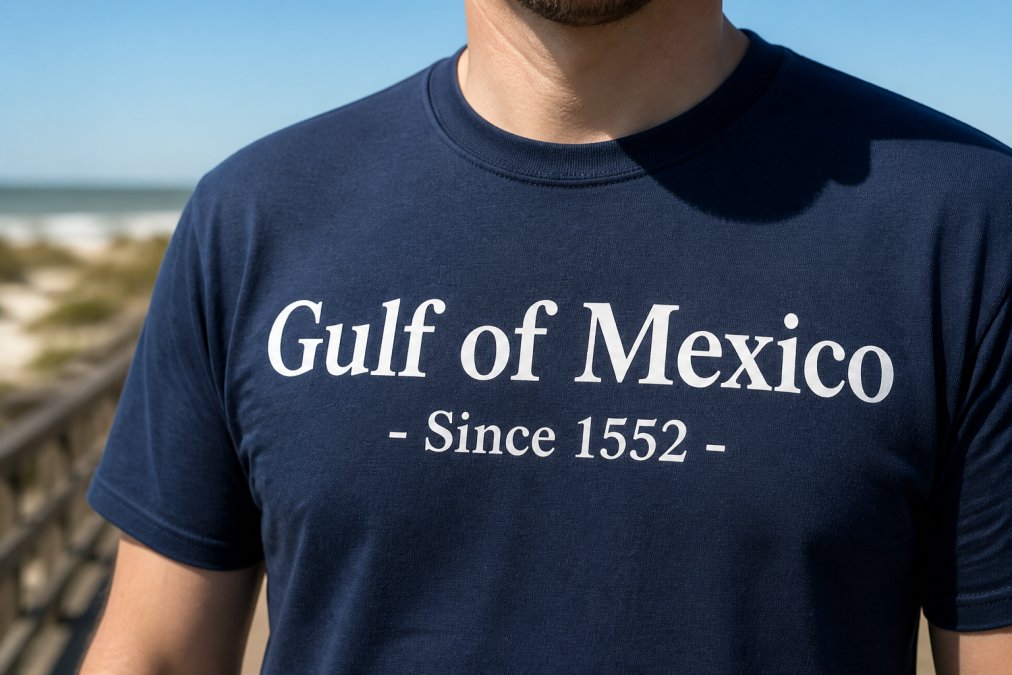
Our designs are built around historical accuracy. They assume the wearer knows the history and wants a shirt that rewards that knowledge.
Corrected Names Tee: Satirical Commentary
The Corrected Names Tee takes recent place-name changes and marks them up the way an editor would, with the corrections highlighted for anyone struggling to keep up. It's $25.00, printed on a soft unisex tee in black.

This is the shirt for people who prefer a raised eyebrow to a raised voice. It lands hardest with anyone who follows the news closely enough to catch the reference.
Gulf of Mexico - Since 1552 Tee: Historical Accuracy
The Gulf of Mexico - Since 1552 Tee leans on nearly five centuries of documented usage. The design borrows the look of a vintage souvenir shirt, so the message reads as nostalgia rather than protest.

At $25.00 in navy, it's the more understated option of the two. It works in a bar, at a ballgame, or anywhere a loud slogan would feel like too much.
| Shirt | Style | Best For | Price |
|---|---|---|---|
| Corrected Names Tee | Satirical, editorial | News-literate audiences | $25.00 |
| Gulf of Mexico - Since 1552 Tee | Vintage souvenir | Everyday, low-friction wear | $25.00 |
Consequences of Wearing Political Gear: Risks and Rewards
The reward is visibility. A political shirt starts conversations, signals belonging, and turns a private belief into public discourse. That's the entire point.
The risk is friction. You may be asked to leave a polling place, pulled into an argument at a family dinner, or quietly passed over for a client-facing meeting. None of that is illegal. All of it is real.
A common mistake is buying a shirt for the statement alone and ignoring where you'll actually wear it. Think through your week before you commit. If the shirt only works on Saturdays, that's fine, as long as you knew that going in.
Frequently Asked Questions
Is it legal to wear political apparel to the polls?
It depends on state regulations. Many states prohibit electioneering within a certain distance of polling places. This includes wearing campaign buttons, partisan gear, or any apparel that could be seen as influencing voters. While the First Amendment protects political expression, states can enforce time, place, and manner restrictions to prevent voter intimidation and ensure a neutral voting environment. Check your specific state's laws before heading to vote.
Can employers restrict political apparel in the workplace?
Yes, private employers generally can restrict political apparel as part of their dress code policy. The First Amendment primarily protects against government action, not private employers. Employers often enforce these policies to maintain a professional environment and avoid potential conflicts among staff. However, some states have laws protecting political expression, so it's important to review your specific state regulations and company handbook.
How does political apparel serve as a form of non-verbal communication?
Political apparel acts as a visible signal of your values, affiliations, and identity. It communicates your stance on issues without you having to say a word. This form of symbolic support can spark conversations, build community with like-minded individuals, and signal opposition to certain policies. However, it can also lead to assumptions about your beliefs and potentially cause tension in mixed company, making it a powerful but sometimes risky form of personal expression.
What is the difference between slacktivism and active engagement?
Slacktivism refers to low-effort online support, like liking a post or sharing a hashtag, which may not lead to real-world action. Active engagement involves tangible steps like attending protests, volunteering, or donating. Wearing politically charged apparel can bridge this gap by making a statement in the physical world. It signals a commitment beyond the digital realm, potentially inviting conversations that lead to deeper involvement. However, critics argue that it can still be a form of slacktivism if not paired with other actions.
Political expression through clothing asks you to weigh conviction against context, and most people get that balance wrong in one direction or the other. Correct Geography makes shirts for the people who want to make their point with historical accuracy instead of volume, including the Corrected Names Tee and the Gulf of Mexico - Since 1552 Tee, both printed on soft unisex cotton at $25.00. Browse the collection and find the design that says what you mean.