
Table of Contents
- What Makes Historical Geography Apparel Authentic
- How to Buy Historical Map Shirts Online Without Getting Burned
- Historical Reproduction Clothing Stores: What Sets Them Apart
- Correct Geography: The Corrected Names Tee
- Correct Geography: The Gulf of Mexico - Since 1552 Tee
- Correct Geography: The Denali - The Great One Tee
- Correct Geography: The Lake Ontario Collection
- Which Historical Geography Apparel Brand Is Right for You?
- Frequently Asked Questions
Last Updated: September 13, 2026
What Makes Historical Geography Apparel Authentic
Authentic historical geography apparel brands build designs on documented place names, verifiable dates, and archival sources rather than trends or political convenience. Correct Geography restores original names to shirts, the Gulf of Mexico, Denali, Lake Ontario, each printed with the date or context that predates the recent rebranding.

A place name carries centuries of maps, treaties, and local usage behind it. A shirt printing "Gulf of Mexico" alongside "Since 1552" makes a claim a buyer can verify against any atlas printed before last year.
The Difference Between Heritage Clothing and Historical Geography Apparel
Heritage clothing refers to garments styled after a past era, such as vintage souvenir tees or traditional workwear silhouettes. Historical geography apparel goes further: its meaning depends on the accuracy of a place name, boundary, or date.
A heritage flannel shirt looks old. A historical geography tee argues something specific about what a place is called and why.
The two overlap in production. Both tend to favor vintage-inspired garment construction and printing methods over fast-fashion shortcuts, and both attract buyers who care about where a product came from.
Why Place-Name Accuracy Matters in Fashion
Place names change for real reasons: language shifts, independence, decolonization. Denali is the clearest American example, called Denali by Alaska Native people for generations before a 2015 federal order restored the name, briefly reverted in 2025, then restored again in 2026 (usgs.gov). A shirt printing "Denali - The Great One" cites the longer record, not the latest headline.
That is the editorial argument behind this category. If a name survived four centuries of use, a t-shirt can reasonably keep it.
How to Buy Historical Map Shirts Online Without Getting Burned
If you want to buy historical map shirts online, verify the source behind the name before the fit. Most problems in this niche trace back to designs that assert a historical name without citing a date, a source, or a reason, and the buyer cannot tell a researched design from a slogan with a map on it until the shirt arrives.
The framework below is what reenactors, map collectors, and archival researchers apply when evaluating a reproduction.
Rank the evidence behind the name
Not all historical claims carry equal weight. A hierarchy, strongest to weakest:
- Primary cartographic sources, a dated map, atlas plate, or survey showing the name in use. The Library of Congress Geography and Map Division and the David Rumsey Map Collection host digitized originals searchable by place name and year (loc.gov).
- Government and institutional records, the U.S. Board on Geographic Names' Geographic Names Information System (GNIS) is the federal register of domestic place names and their decision dates. A name with a GNIS entry is checkable in minutes.
- Named historical accounts, a specific explorer, surveyor, or chronicler tied to a year, as with Samuel de Champlain and Lake Ontario in 1615. Strong when named; weak when the brand says only "historically."
- Cultural and Indigenous usage, oral and community records predating written documentation, as with Denali. Legitimate but hard to verify independently, so the strongest designs pair it with a documented date.
- Vibes, a vintage typeface, a distressed print, a sunset. This is decoration, not evidence.
A design citing level 1 or 2 evidence is auditable. One citing only level 5 is asking for trust it has not earned.
Red flags that separate historical-inspired fast fashion from real reproduction work
- No date on the product page. A year is the cheapest proof of research; its absence is a signal.
- A date only in marketing copy, never in the design. If the shirt says "Est. 1615" but the page never explains 1615, the number is set dressing.
- Place names that change with the news cycle. A brand that quietly updates a design after a political rebrand is selling merchandise, not history.
- No fabric or construction spec. If the page won't state fabric weight, cotton content, or stitching, assume the cheapest blank.
- Stock photography instead of product photography.
- A design that needs a caption to make sense. If the shirt cannot carry its own argument, the argument is not in the shirt.
A verification checklist you can run in five minutes
- Does the product page state a specific year, era, or source for the name?
- Can you find that name and year in GNIS, a digitized atlas, or a named historical account, not just on the brand's own page?
- [ ]
- Is the garment specification listed (fabric weight, cotton content, construction details)?
- Does the design work as a standalone object, or does it require a caption to make sense?
- Does the brand explain its reasoning in product copy, or only in lifestyle language?
What "authentic" should mean on a product page
A brand that wants authentic to mean something must publish three things every time: the name, the date, and the source. Correct Geography does this, the Gulf of Mexico tee prints "Since 1552" and explains the date in the product description, and the Lake Ontario - Est 1615 Tee cites the year Samuel de Champlain became the first recorded European to encounter the lake. Both claims can be checked against a public record.
That is the standard worth holding the whole category to. A historical geography shirt should be the rare piece of apparel that gets more convincing the more you look into it.
Historical Reproduction Clothing Stores: What Sets Them Apart
Historical reproduction clothing stores differ from general retailers in one structural way: they treat the design as a document. The product page must carry the same weight as the garment, and the garment the same weight as the claim.
The reproduction techniques that actually matter
Historical reproduction is a set of choices, each trading cost against fidelity:
- Print-to-order vs. inventory. Print-to-order keeps a design available as long as its argument holds and avoids the seasonal-drop cycle. Trade-off: longer fulfillment, no bulk pricing.
- Screen printing vs. direct-to-garment. Screen printing lays a thicker, more durable ink layer and better matches mid-century souvenir and workwear printing. Direct-to-garment is cheaper at low volume but fades faster and sits on top of the fabric.
- Ring-spun vs. open-end cotton. Ring-spun yields a smoother, stronger yarn and softer hand; open-end is faster and cheaper. Specifying ring-spun tells you which trade-off the store made.
- Garment construction details. Shoulder-to-shoulder taping, double-stitched necklines and sleeves, and a quarter-turned body to prevent a center crease mark a blank built to survive repeated washing, the same details mid-century American knitters used, and the first a cost-cutting supplier removes.
- Cut and silhouette. A reproduction that uses a modern slim fit is reproducing the print, not the garment. Stores that care about period accuracy will say so in the fit notes.
Regional manufacturing heritage and where the materials come from
What the strongest stores have in common
The strongest stores publish the source of a name or date, avoid seasonal drops because a place name doesn't go out of style, and specify the garment because construction is a claim like any other.
Correct Geography follows this model: every design is on a 100% ring-spun cotton tee with shoulder-to-shoulder taping, double-stitched neckline and sleeves, and a quarter-turned body to prevent a center crease. Fabric weight is 4.5 oz/yd² (153 g/m²), a mid-weight most people find wearable year-round.
That spec list is itself transparency. A store that tells you fabric weight and stitching usually also tells you the year a name was established.
Correct Geography: The Corrected Names Tee
The Corrected Names Tee is the brand's thesis statement: three recent place-name changes, the Gulf of Mexico, the Kennedy Center, and Lake Ontario, with the necessary corrections highlighted for anyone having trouble keeping up.

No map, no mountain, no sunset, just a short remedial geography lesson on a soft, lightweight ring-spun cotton tee. At $25.00, it is the most direct expression of the brand's argument: some names were fine before someone got hold of a Sharpie.
Correct Geography: The Gulf of Mexico - Since 1552 Tee
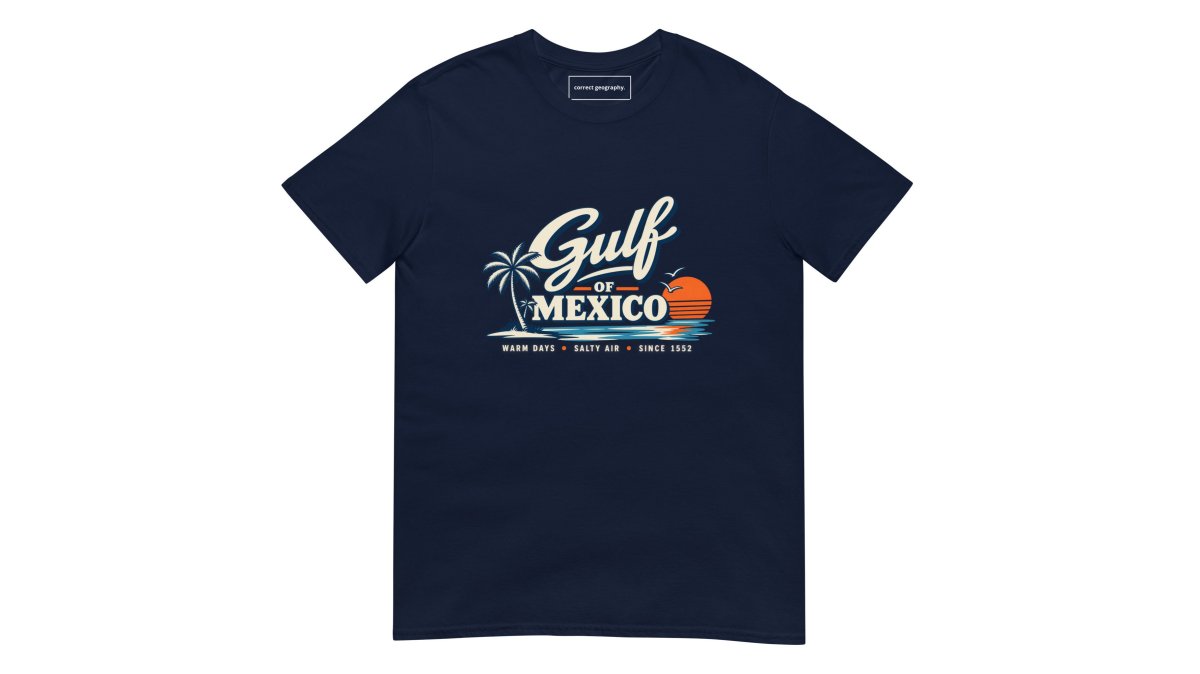
The Gulf of Mexico - Since 1552 Tee leans on the vintage 1970s-80s souvenir aesthetic, with "Warm Days - Salty Air - Since 1552" across a navy tee. The date does the work, placing the name nearly five centuries back, well before any recent executive order touched it.
At $25.00, on the same ring-spun cotton base, this is for someone who wants the history to speak without a caption. As the product copy puts it: place names may be subject to political whims, but your t-shirt does not automatically update.
Correct Geography: The Denali - The Great One Tee
Denali - The Great One Tee cites the name Alaska Native people used for the mountain for centuries, alongside the 20,310-foot elevation. The vintage Alaska souvenir format reads as state heritage rather than protest.

For buyers who care about the history but not the fight, this is the easiest design to wear. It states a fact, not an opinion. $25.00.
Correct Geography: The Lake Ontario Collection
The Lake Ontario collection splits into two designs, and the split shows how the brand thinks.
The Lake Ontario - Few Americans Tee plays the vintage winter souvenir angle, with "Cold Days - Clear Skies - Few Americans" across a navy tee. It is the wittier of the two, acknowledging the lake's mostly Canadian shoreline without complaint.
The Lake Ontario - Est 1615 Tee strips the humor out entirely: classic vintage script and the year Samuel de Champlain became the first recorded European to encounter the lake. No slogan, no argument, explain it or let them look it up.
Both are $25.00, on the same ring-spun cotton base.
Which Historical Geography Apparel Brand Is Right for You?
Correct Geography treats place names as verifiable claims rather than slogans. The catalog covers five designs, all on 100% ring-spun cotton at 4.5 oz/yd², each attaching a date or source to the name it defends. For buyers who want history that holds up to a search, that is the standard that matters.
If you want a shirt that argues a point, start with the Corrected Names Tee. If you want one that simply states a fact, the Denali tee or the Lake Ontario - Est 1615 tee will do it without a caption.
Most apparel claims about history are decorative, not verifiable. Correct Geography closes that gap: every design cites a date, a record, or a name predating the recent change, and every shirt is on a specified ring-spun cotton base with double-stitched construction and shoulder-to-shoulder taping. If you want a shirt that can survive a fact-check, browse the Correct Geography catalog and pick the design whose argument you are willing to wear.
Frequently Asked Questions
What defines authentic historical geography apparel?
Authentic historical geography apparel uses verified original place names, documented dates, and accurate geographic references. It relies on archival research and historical context rather than trend-driven design. Brands like Correct Geography print names such as Denali and Lake Ontario with their original spellings and established dates, ensuring each garment reflects genuine geographic heritage rather than contemporary rebranding.
How do I verify the historical accuracy of geography-themed apparel?
Check whether the brand cites specific dates, original names, and verifiable sources. Look for details like 'Since 1552' or 'Est. 1615' that reference documented history. Cross-reference place names with historical records and maps. A trustworthy brand will explain its sourcing and provide historical context, not just a design. Correct Geography, for example, highlights the year Samuel de Champlain encountered Lake Ontario and the centuries-old Denali name.
Where can I buy historical map shirts online?
You can buy historical map shirts online directly from Correct Geography at correctgeography.com. Their collection includes the Corrected Names Tee, Gulf of Mexico - Since 1552 Tee, Denali - The Great One Tee, and the Lake Ontario collection. Each shirt is on soft ring-spun cotton and priced at $25.00. Shopping direct ensures you get accurate designs and can review the historical context behind each piece.
What is the difference between heritage clothing and historical geography apparel?
Heritage clothing focuses on traditional manufacturing methods, durable materials, and classic silhouettes, like selvedge denim or waxed jackets. Historical geography apparel centers on place-name accuracy and geographic history. It uses clothing as a canvas for archival research, featuring original names and dates. While heritage clothing emphasizes how a garment is made, historical geography apparel emphasizes what it says and why that matters.
Are there clothing brands that specialize in original place names?
Correct Geography is a brand that specializes in original place names. Their designs feature names like the Gulf of Mexico, Denali, and Lake Ontario with historical dates and context. Each shirt aims to preserve geographic accuracy and resist arbitrary renaming. You can find their collection at correctgeography.com, where designs are priced at $25.00 per tee.