
Table of Contents
- Why Buy Shirts With Historical Accuracy Instead of Trend-Driven Graphics?
- Quick Comparison: Our Top Picks for Historically Accurate Shirts
- 1. Corrected Names Tee: The Sharpie Correction You Can Wear
- 2. Gulf of Mexico - Since 1552 Tee: A Vintage-Style Stand Against Renaming
- 3. Denali - The Great One Tee: Respecting Names That Predate Politics
- How to Verify Historical Accuracy in Clothing Designs Before You Buy
- Where to Buy Historical Map Shirts Online That Meet Museum Standards
- Which Historically Accurate Shirt Should You Pick?
- Frequently Asked Questions
Last Updated: September 9, 2026
Why Buy Shirts With Historical Accuracy Instead of Trend-Driven Graphics?
Most political apparel disappears the moment the news cycle turns. A shirt that says "buy shirts with historical accuracy" on the label holds a position that doesn't expire when the next controversy arrives. At Correct Geography, we build our catalog around original place names, not reactionary slogans, because a geographic fact outlasts any administration.
The difference comes down to permanence. Trend-driven graphics chase whatever happened last week, so they age poorly and end up in the donation bin within a season. Historically accurate designs reference documented names, some centuries old, so they stay relevant and defensible no matter what changes in Washington. You are wearing a record of what the map actually said before someone with a Sharpie decided otherwise.
Buying shirts with historical accuracy also signals something about how you process information. It tells people you checked the source, you know the original name, and you are comfortable explaining why it matters.
Quick Comparison: Our Top Picks for Historically Accurate Shirts
Each of the three shirts below approaches historical accuracy from a slightly different angle, so the right pick depends on the statement you want to make.
| Shirt | Price | Historical Reference | Best For |
|---|---|---|---|
| Corrected Names Tee | $25.00 | Three renamed places in one design | A direct, corrective statement |
| Gulf of Mexico - Since 1552 Tee | $25.00 | Name in use since 1552 | Vintage souvenir style, coastal pride |
| Denali - The Great One Tee | $25.00 | Alaska Native name, centuries old | Respecting indigenous heritage |
All three are printed on soft, lightweight ring-spun cotton at 4.5 oz/yd², with double-stitched necklines and sleeves. None of them require a geographic update, which is rather the point.

1. Corrected Names Tee: The Sharpie Correction You Can Wear
Our top pick is the Corrected Names Tee, because it addresses the core problem directly: recent renames that solved nothing. The design features three names, the Gulf of Mexico, Kennedy Center, and Lake Ontario, with the necessary corrections highlighted in red. No maps, no mountains, no majestic sunsets. Just a short remedial geography lesson printed on your chest.

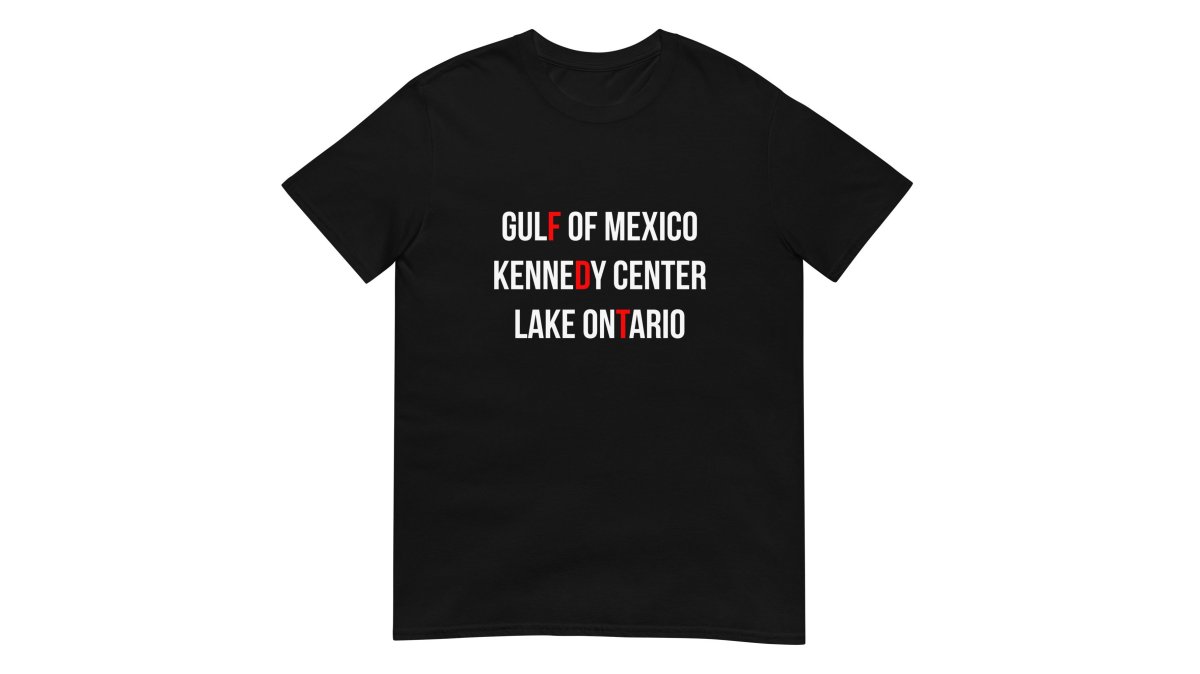
What makes this shirt historically accurate is its restraint. It does not argue; it simply restores. The red correction marks mirror how a teacher would grade a wrong answer, which lands with people who care about getting names right. At $25.00, it is the most versatile option because it covers three separate issues in a single garment.
2. Gulf of Mexico - Since 1552 Tee: A Vintage-Style Stand Against Renaming
The Gulf of Mexico has carried its name since 1552, nearly five centuries before any recent political debate. This shirt celebrates that history with a vintage 1970s-80s souvenir design, complete with the tagline "WARM DAYS, SALTY AIR, SINCE 1552." It is a statement about permanence wrapped in nostalgia.
What most guides miss is how the vintage styling changes the message. A modern graphic tee screams protest; a retro souvenir shirt whispers quiet confidence. People read it as coastal heritage rather than a reaction to current events, making it easier to wear in mixed company while still landing the point.
The shirt's historical accuracy rests on a verifiable date. The name "Gulf of Mexico" appears on maps from the mid-16th century, long before the United States even existed as a nation. That documentation matters if someone challenges you on the design.
3. Denali - The Great One Tee: Respecting Names That Predate Politics
North America's tallest mountain rises 20,310 feet, and Alaska Native people called it Denali, "The Great One," for centuries before any federal agency weighed in. This shirt honors that original name with a vintage 1970s-80s Alaska souvenir design featuring "WILD LAND, MIDNIGHT SUN, LASTING IMPRESSIONS." It is the most historically grounded option in the lineup.

The Denali tee works differently from the other two because it celebrates an indigenous name rather than correcting a recent one. That makes it the most approachable choice for people who care about cultural heritage but prefer not to lead with confrontation.
For $25.00, you get a shirt that respects centuries of Alaska Native naming tradition while gently mocking the futility of renaming a mountain.
How to Verify Historical Accuracy in Clothing Designs Before You Buy
The term "historically accurate" is thrown around loosely. A t-shirt with a Roman numeral or a Viking helmet is often labeled as such, but true accuracy is a spectrum. You must first understand the difference between history-themed and historical reproduction. A history-themed shirt uses historical motifs for aesthetic appeal; a historical reproduction aims to replicate a specific garment's construction, materials, and design as it would have existed in a particular era. Most shirts you find online, including graphic tees, fall into the former category.
If you are looking for a true reproduction, the verification process is rigorous. Here is a practical framework used by living history interpreters and museum curators, which you can apply to any purchase.
1. Scrutinize the Fabric Content.
The single most important factor in a reproduction is the textile. Before the mid-19th century, most clothing was made from natural fibers: linen, wool, and cotton. A shirt claiming to be an 18th-century reproduction made from a modern poly-cotton blend is an immediate red flag. Look for specific fiber content and fabric weight. For example, a mid-19th-century work shirt would typically be made of a heavyweight, coarse-woven cotton or linen, often referred to as "osnaburg" or "linsey-woolsey." A modern t-shirt, even a 100% cotton one, is a knit fabric, not a woven one, and would be entirely inappropriate for any period before the 20th century.
2. Examine the Construction and Stitching.
Machine stitching became common in the mid-19th century, but the type of stitch matters. A modern overlock or serged seam is a dead giveaway for a modern garment. Period-appropriate construction uses flat-felled seams, French seams, or simple run-and-fell stitches. Look at the buttonholes. Are they hand-worked or machine-made? The number of stitches per inch and the type of thread are also telling. A reproduction from the 1860s would use cotton thread, not the synthetic thread used in modern apparel.
3. Check the Pattern and Cut.
Clothing silhouettes have changed dramatically over the centuries. An 18th-century shirt, for example, was cut from rectangular pieces of fabric with minimal waste, featuring gussets under the arms and a simple, square-cut collar. A 19th-century shirt might have a more fitted body and a standing collar. If a shirt has a modern, contoured fit with darts or elastic, it is not a reproduction. Compare the garment's silhouette to period paintings, photographs, or extant examples in museum collections. The National Park Service living history guidelines provide excellent resources on the evolution of clothing construction.
4. Distinguish Between Design and Construction.
For the purposes of this article, the shirts we offer are not historical reproductions. They are history-themed garments. Their accuracy lies in the verifiable facts they present, the names, dates, and geography, not in their construction. A modern ring-spun cotton t-shirt is a comfortable, durable canvas for a historically accurate message. We do not claim it is a replica of a 16th-century doublet or a 19th-century union suit. When you buy a shirt with historical accuracy, you are buying a garment that respects the past in its design and message, not one that pretends to be from the past.
By applying this framework, you can move beyond marketing buzzwords and make an informed choice. You can decide if you want a comfortable shirt that starts a conversation about a historical fact, or a complex, period-correct garment that is a piece of history in itself.
Where to Buy Historical Map Shirts Online That Meet Museum Standards
The online market for historically-focused apparel is a spectrum with three distinct tiers, each serving a different purpose and budget. Understanding these tiers is the first step to a successful purchase.
Tier 1: The Graphic Tee (History-Themed)
This is the most common tier, populated by large e-commerce platforms and print-on-demand services. These are modern t-shirts, hoodies, or sweatshirts printed with historical quotes, maps, or portraits. The focus is on the graphic, not the garment. The historical accuracy is in the design itself, the correctness of a quote, the details on a map, or the authenticity of a portrait. This is where our shirts at Correct Geography fit. We prioritize the verifiable accuracy of the geographic names and dates we print. The garment is a high-quality, comfortable canvas, but it is not a period reproduction. The Smithsonian Institution guidance on historical interpretation supports the idea that even casual apparel can play a role in public history when its message is accurate.
Tier 2: The Reenactment Supplier (Historical Reproduction)
This tier is for the serious living historian or reenactor. Companies like Jas. Townsend & Son, Wm. Booth, Draper, or Sutler's Store specialize in period-correct clothing. Here, you are not buying a t-shirt; you are buying a shirt made of linen or wool, cut and sewn according to 18th or 19th-century patterns. The standards are rigorous, and the prices reflect the labor and materials. A single, hand-sewn linen shirt from the 1770s can easily cost $150 to $300. These garments are not for casual wear; they are for events, demonstrations, and educational programs. The National Park Service living history guidelines are the gold standard for this tier, dictating everything from fabric weight to button material.
Tier 3: The Museum-Quality Atelier (Custom Reproduction)
This is the rarest and most expensive tier. These are artisans and small shops that create museum-grade reproductions for exhibits or high-end collectors. They might use historically accurate dyes, hand-spun thread, and period-specific weaving techniques. The cost can run into the thousands of dollars for a single garment.
A Practical Guide to Your Purchase
- For a conversation starter or a gift for a history buff: Tier 1 is your target. Look for a seller who can articulate why their design is accurate. Do they cite sources? Do they explain the historical context? If they just slap a date on a design without evidence, move on.
- For a reenactment or living history event: You must go to Tier 2. Do not attempt to adapt a Tier 1 t-shirt. You will be anachronistic and detract from the immersive experience. Check the specific event's guidelines, as they often have strict rules about what is acceptable.
- For a museum or educational collection: You would work directly with a Tier 3 artisan, not a website.
Our catalog focuses on the first tier, offering designs that are historically and geographically accurate. We do not claim to be a reenactment supplier. We are a resource for those who want to make a statement about history in their everyday wardrobe.
Which Historically Accurate Shirt Should You Pick?
If you want one shirt that addresses the renaming trend across multiple places, the Corrected Names Tee is the strongest statement. If you prefer a subtler, coastal-themed design that celebrates a name with five centuries of documented use, the Gulf of Mexico - Since 1552 Tee fits better. If you want to honor indigenous heritage without leading with confrontation, the Denali - The Great One Tee is the clear choice.
All three shirts cost $25.00 and share the same quality construction: 100% ring-spun cotton, 4.5 oz/yd² fabric weight, shoulder-to-shoulder taping, and a double-stitched neckline. The design stays current with your values, not with whatever name is politically convenient this week. As Smithsonian Institution guidance on historical interpretation notes, accuracy in representation matters because it shapes how we understand the past.
The real question is whether you want your apparel to reflect documented geography or passing political whims. The map has the final word, and the map says these names were correct long before anyone tried to change them.
Frequently Asked Questions
How do I know the place names on these shirts are actually historically accurate?
Correct Geography prints names with verifiable historical documentation. The Gulf of Mexico has carried that name on maps since 1552, long before modern political debates. Denali has been the Alaska Native name for North America's tallest peak for centuries. Each design cites the original, documented name rather than a recent executive change, so the historical accuracy is based on cartographic and cultural records, not opinion.
What is the difference between vintage-style shirts and historically accurate apparel?
Vintage-style shirts borrow a retro look, like 1970s-80s souvenir graphics, for aesthetic appeal. Historically accurate apparel focuses on the factual correctness of what is printed. The Gulf of Mexico tee uses a vintage design style, but its core value is the accurate 1552 date and the original place name. Correct Geography combines both: a nostalgic aesthetic with verified historical place names.
Are these shirts made with quality fabric that will hold up to regular washing?
Yes. Each tee is printed on a 100% ring-spun cotton base (4.5 oz/yd²) with a double-stitched neckline and sleeves. The fabric is quarter-turned to prevent a center crease and features shoulder-to-shoulder taping for durability. The Corrected Names Tee and Gulf of Mexico tee are priced at $25.00, offering a soft, lightweight feel with enough structure to last through repeated wears.
Can I buy historical map shirts online that show original place names?
Yes. Correct Geography sells shirts online that feature original place names with documented historical roots. The Denali tee celebrates the mountain's centuries-old Alaska Native name, while the Gulf of Mexico tee honors a name used since 1552. Each product page includes the historical context behind the design, so you can verify the accuracy before purchasing.
Will people understand the message on my shirt, or will it look like a random geography tee?
The designs use familiar place names that are currently in the news, so the context is fresh for most observers. The Corrected Names Tee makes the point explicit by listing the Gulf of Mexico, Kennedy Center, and Lake Ontario with corrections highlighted in red. It reads as a deliberate political and historical statement rather than a generic map graphic.
Choosing apparel that reflects historical accuracy means rejecting the impulse to rename what already has a proper name. Correct Geography builds every shirt around original place names, verified against cartographic history, and prints them on soft, durable ring-spun cotton with a comfortable unisex fit. Get started with Correct Geography and wear the map as it was meant to be read.