
Table of Contents
- Why History Buffs Are Rethinking Their Activist Wardrobe
- What Makes a Good AllRiot Alternative for History Buffs
- History Themed Apparel Brands That Get the Details Right
- Authentic Historical Graphic Tees: What to Look For
- Niche Historical Eras: Finding Your Specific Interest
- Sustainable and Ethically Sourced Historical Apparel
- Comparing Your Options: A Quick Reference
- Frequently Asked Questions
Last Updated: September 10, 2026
Why History Buffs Are Rethinking Their Activist Wardrobe
The case for an AllRiot alternative for history buffs starts with a simple problem: most activist apparel treats history as decoration. If you care whether the Gulf of Mexico was the Gulf of Mexico before anyone in Washington decided otherwise, a shirt built around a slogan rather than a source will disappoint you. This guide from Correct Geography examines what separates a genuinely researched historical tee from a generic political print, and how to choose accordingly.

There is a real gap in the market here. Most political streetwear is designed to be read at a distance, not studied up close. History buffs want the opposite: garments that reward a second look and hold up to a follow-up question at a museum gift shop or a family reunion.
Below, we break down the criteria that actually matter, from print durability to sourcing ethics, so you can find apparel that matches both your politics and your standards.
What Makes a Good AllRiot Alternative for History Buffs
A good AllRiot alternative for history buffs is any brand that treats historical accuracy as a design requirement, not a marketing angle. That means verified dates, correct place names, and print quality that survives repeated washing without cracking or fading.
Three things separate a serious option from a novelty shirt:
- Sourced claims. Every date or name on the garment should be traceable to a real historical record.
- Print integrity. Screen-printed or direct-to-garment methods that hold up over dozens of washes.
- Editorial restraint. A shirt that makes one clear point beats one covered in five competing slogans.
The Smithsonian's guide to historical research standards is a useful reference point for what "verified" should mean when a brand makes a historical claim.
Print-on-Demand vs. Curated Historical Collections
Print-on-demand services let anyone upload a design and sell it within minutes. Curated collections work differently: a brand selects a limited set of designs, researches each one, and stands behind the accuracy of every item it ships.
The trade-off is speed versus trust. Print-on-demand wins on variety and price flexibility. Curated collections win on consistency, because someone has actually checked the facts before the shirt goes on sale. For history buffs, that verification step is usually worth the wait.
History Themed Apparel Brands That Get the Details Right
The brands worth your money share one habit: they explain their reasoning. A shirt that says a place name has been used "since 1552" should be able to tell you why that date matters, and a brand that can't is guessing. That single test, can the brand answer a follow-up question?, filters out most of the market before you ever look at a price tag.
A Four-Part Test You Can Apply to Any Brand
Rather than naming a single winner, it's more useful to give you a framework. Run any history-themed apparel brand through these four questions:
- Does it cite a source? Not "historically accurate", an actual archive, catalog, treaty, or map. A brand that names the Smithsonian, the National Archives, or a specific state historical society is telling you where its claims come from.
- Does it date the claim? "Since 1552" is a claim. "Centuries-old name" is a vibe. The first is checkable; the second isn't.
- Does it describe the print method? Screen printing, direct-to-garment, and heat transfer all wear differently. A brand that specifies the method is usually a brand that has thought about how the shirt ages.
- Does it disclose fabric composition by colorway? Heather colors are almost always a cotton-polyester blend, and the exact split varies. A brand that publishes the split per color is doing more than most.
How Correct Geography Measures Up
Correct Geography is a clear example of this approach. The brand sells t-shirts featuring original place names, built around the idea that some names were perfectly serviceable before they were changed for political reasons. Its National Archives catalog style of sourcing, favoring documented names over invented ones, is exactly the standard history buffs should expect.
Run it through the four-part test and the pattern holds. The claims are dated (1552 for the Gulf of Mexico name; the pre-renaming record for Denali). The print method is stated. The fabric composition is published per colorway, including the cotton-polyester split for heathers. That's four out of four, which is rarer than it should be.
That editorial discipline shows up in the product line. The Gulf of Mexico - Since 1552 Tee ($25.00) leans on nearly five centuries of documented use, styled after a vintage 1970s-80s souvenir shirt. The Denali - The Great One Tee ($25.00) makes a similar point about a mountain name that predates any recent political debate. Neither design relies on a slogan to carry the argument.

What the Weak Options Look Like
The brands that fail the test tend to fail in the same ways. They use the word "vintage" as a style descriptor rather than a date. They reproduce a quote without naming the speech or the year. They list "cotton blend" without saying what the blend is. None of these are fatal on their own, but together they signal that no one checked anything before the shirt went on sale.
Authentic Historical Graphic Tees: What to Look For
Authentic historical graphic tees are defined by accuracy, not aesthetics. A vintage-looking font means nothing if the date printed next to it is wrong, and a shirt can look beautiful while still getting the history backwards.
Check three things before you buy:
- The claim itself. Is the date, name, or event verifiable?
- The visual style. Does it match the era it's referencing, or is it a generic modern template?
- The print method. Can the brand tell you how the graphic is applied and how it wears over time?
Fabric, Fit, and Print Quality
Fabric weight and construction matter more than most buyers expect. A 4.5 oz/yd² (153 g/m²) ring-spun cotton tee, like the ones Correct Geography uses, sits in the sweet spot: soft enough for daily wear, structured enough to hold a print without sagging.
Look for shoulder-to-shoulder taping and double-stitched necklines and sleeves. These details keep a shirt's shape after repeated washes, which matters when the graphic is the whole point. A quarter-turned cut also prevents the center crease that plagues cheaper blanks.
Niche Historical Eras: Finding Your Specific Interest
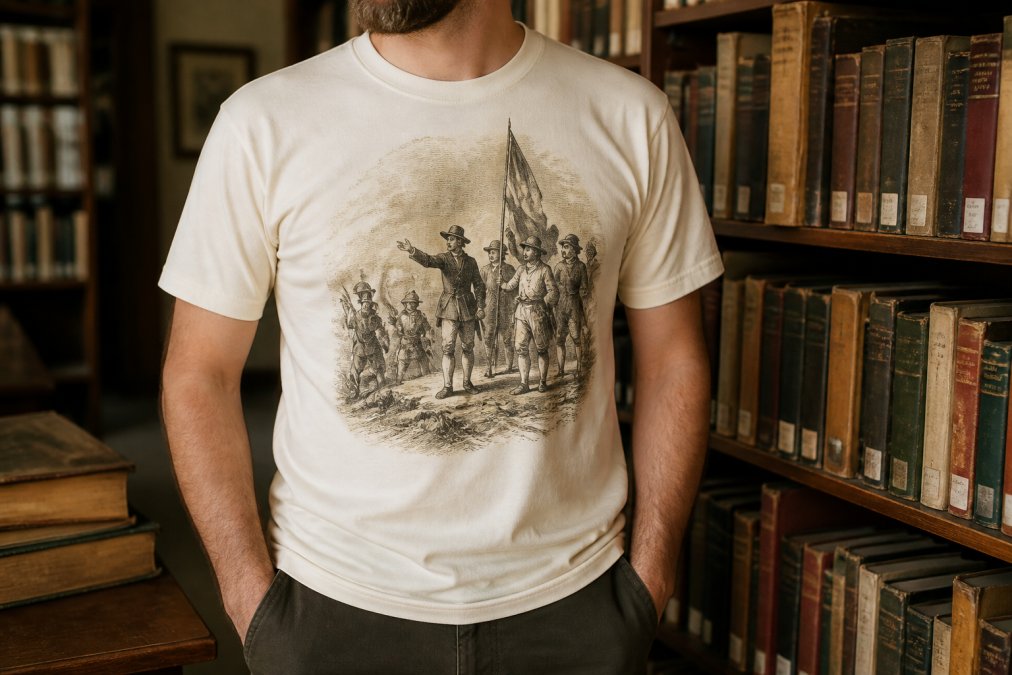
Niche historical era categorization is what separates a thoughtful gift guide from a generic one. Revolutionary War, Civil War, and WWII era designs each carry different visual conventions, different sourcing traps, and different things a buyer should verify before spending money. A brand that understands those differences produces better shirts; a buyer who understands them avoids the ones that just look old.
The table below is a starting point, but the notes underneath it are where the real filtering happens.
| Era | Visual Style | What to Verify |
|---|---|---|
| Revolutionary War | Colonial typography, muted tones, hand-lettered feel | Original spellings, document dates, whether a quote is attributed to the right person |
| Civil War | Archival letterpress look, sepia and ink tones | Regimental names, battle dates, state and county spellings as they existed then |
| WWII era | 1940s poster styling, limited wartime palette | Home-front slogan wording, Office of War Information poster sources, ration-era dates |
| Modern geography disputes | Vintage souvenir styling | The name's documented first use and the map or record it appears on |
Revolutionary War designs. The most common error here is a quote attributed to the wrong founder or dated to the wrong year. Printers in the 1770s used the long s (which looks like an f), inconsistent capitalization, and spellings that modern fonts quietly "correct." A shirt that renders "Congress" in clean modern sans-serif is making a stylistic choice, not a historical one, and that's fine, as long as the brand says so. What isn't fine is a date that's off by a decade.
Civil War designs. Regimental designations are the trap. A unit might be listed as "20th Maine" in one source and "20th Maine Volunteer Infantry" in another, and both can be correct depending on the record. Battle dates are also frequently confused with siege dates, a distinction that matters to anyone who has actually read a regimental history. Look for brands that name the specific source they pulled from.
WWII era designs. Home-front slogans are the most reproduced and the most misquoted. Wartime poster text was often shortened for layout, and the shortened version is what gets printed today. If a brand can't tell you whether its slogan comes from the original poster or a later paraphrase, treat the design as decorative rather than documentary.
Modern geography disputes. This is where Correct Geography operates, and it's a category most gift guides skip entirely. The verification standard is different from the other three eras: instead of a battle or a document, you're checking the first documented use of a place name. That means looking at when a name appears on a map, in a treaty, or in a government record, and being able to say which one.
The practical takeaway: pick the era you actually care about, then check whether the brand's sourcing depth matches that era's specific failure mode. A brand that's excellent at WWII poster reproduction may have nothing useful to say about colonial typography.
Sustainable and Ethically Sourced Historical Apparel
Sustainable and ethically sourced historical apparel is the gap most competitors ignore. Print-on-demand reduces waste by printing only what's ordered, but it says nothing about where the cotton comes from or how the workers who make the shirt are treated (the EPA).
A few practical questions cut through the marketing:
- Does the brand print to order, or hold unsold inventory?
- Is the cotton ring-spun and traceable, or unspecified?
- Does the brand disclose fabric composition by colorway, down to the polyester blend percentages?
Correct Geography prints to order and publishes full fabric specs for every tee, including the exact cotton-polyester split for heather colorways. That level of disclosure is rare, and it's the kind of detail that separates a curated collection from a drop-shipped one.
Comparing Your Options: A Quick Reference
Comparing an AllRiot alternative for history buffs comes down to three factors: whether the brand verifies its historical claims, how transparent it is about materials, and whether the design style matches your interest.
| Factor | Generic Political Merch | Curated Historical Collections |
|---|---|---|
| Historical sourcing | Rarely disclosed | Documented and cited |
| Fabric transparency | Vague or absent | Full composition listed |
| Print method | Often unspecified | Stated, with durability in mind |
| Design focus | Slogans first | Accuracy first |
| Price | Varies widely | Around $25 per tee |
The Corrected Names Tee ($25.00) is a good example of the curated model in practice: three documented corrections, printed in red for clarity, on a ring-spun cotton blank with double-stitched seams. It's a shirt that invites a conversation rather than ending one.

Frequently Asked Questions
What should I look for in an AllRiot alternative for history buffs?
Focus on factual accuracy, source transparency, and material quality. Look for brands that cite historical records for their place names or events, use soft ring-spun cotton, and offer durable prints. An AllRiot alternative should prioritize education over generic political messaging, ensuring the apparel sparks conversation rather than confusion.
Are there ethical alternatives to mass-market political t-shirt sites?
Yes. Many smaller brands now use print-on-demand to reduce waste and offer ethically sourced cotton. Look for companies that print to order, avoid overstock, and provide details on fabric origin. These practices reduce environmental impact while delivering unique, historically accurate designs that mass-market sites often overlook.
How do I find apparel that accurately represents historical events?
Check for specific dates, original names, and cited sources. For example, a tee referencing the Gulf of Mexico since 1552 shows a clear historical anchor. Avoid vague slogans. Brands that explain their research, like noting Native American names for mountains, demonstrate a commitment to accuracy that history enthusiasts appreciate.
What are the best clothing brands for history enthusiasts?
The best brands blend comfort with credible historical references. Look for 100% ring-spun cotton, double-stitched seams, and designs that celebrate original place names or events. Correct Geography offers tees like the Denali - The Great One Tee, which honors indigenous names, making it a strong choice for those who value authenticity.
Finding apparel that respects both your politics and your standards for accuracy takes more digging than most gift guides suggest, but the payoff is a shirt you'll actually defend in conversation. Correct Geography builds its entire catalog around that idea, printing original place names on soft ring-spun cotton tees with double-stitched construction and full fabric disclosure, all for $25.00 per shirt. Get started with Correct Geography and wear a name that was correct the first time.