
Table of Contents
- The Best Shirts for Political Expression in 2026
- Fabric Weight Guide for T-Shirts: What GSM and Ounces Tell You
- How to Identify High-Quality Screen Printing
- Fabric Quality, Certifications, and Ethical Manufacturing
- Durability, Shape Retention, and Garment Lifespan
- Ink Toxicity and End-of-Life Garment Disposal
- Conclusion
- Frequently Asked Questions
Last Updated: September 18, 2026
The Best Shirts for Political Expression in 2026
Quality standards for activist graphic tees come down to four measurable things: fabric weight, print method, fiber content, and labor certification. At Correct Geography, we print political and historical designs on 100% ring-spun cotton at 4.5 oz/yd² (153 g/m²).
Most politically charged shirts are sold on emotion and printed on whatever blank was cheapest that month. The message outlives the garment by about six washes.
This guide breaks down what separates a shirt you'll wear for years from one that cracks, fades, and twists after a month: GSM and ounces, screen printing versus direct-to-garment, certifications worth trusting, and end-of-life disposal.
The Federal Trade Commission's guidance on textile labeling requires accurate fiber content disclosure on garment labels, which gives you a legal starting point for verifying what you're actually buying.
Fabric Weight Guide for T-Shirts: What GSM and Ounces Tell You
Fabric weight is the mass of one square yard (or square meter) of fabric, expressed in ounces per square yard or grams per square meter (GSM). It determines how a shirt drapes, how long it lasts, and how it feels in July.
Higher GSM means denser, heavier fabric. Lower GSM means lighter and more breathable. Neither is automatically better; the right number depends on how you wear the shirt.
| Fabric Weight | Typical Use | Durability | Breathability |
|---|---|---|---|
| 3.5-4.0 oz (120-135 GSM) | Fashion cuts, layering | Low | High |
| 4.2-4.7 oz (140-160 GSM) | Everyday graphic tees | Moderate | High |
| 5.0-5.5 oz (170-185 GSM) | Workwear, structured fits | High | Moderate |
| 6.0+ oz (200+ GSM) | Heavyweight, streetwear | Very high | Low |
Why Fabric Weight Matters for Activist Apparel
A protest shirt gets worn hard, rallies, marches, washing machines, sweat. Lightweight fabric under 4 oz tends to thin at the shoulders and develop pinholes within a season.
The 4.2-4.7 oz range is the sweet spot for graphic tees: heavy enough to hold a print without puckering, light enough for summer heat.
Fiber quality matters just as much. Ring-spun cotton spins fibers into a tighter, smoother yarn, so it feels softer and resists pilling better than open-end cotton. Our Corrected Names Tee uses 100% ring-spun cotton at 4.5 oz/yd² (153 g/m²), with shoulder-to-shoulder taping and double-stitched necklines and sleeves.

How to Identify High-Quality Screen Printing
High-quality screen printing shows three things: a soft hand feel, sharp edges on fine detail, and ink that sits in the fabric rather than on top of it.
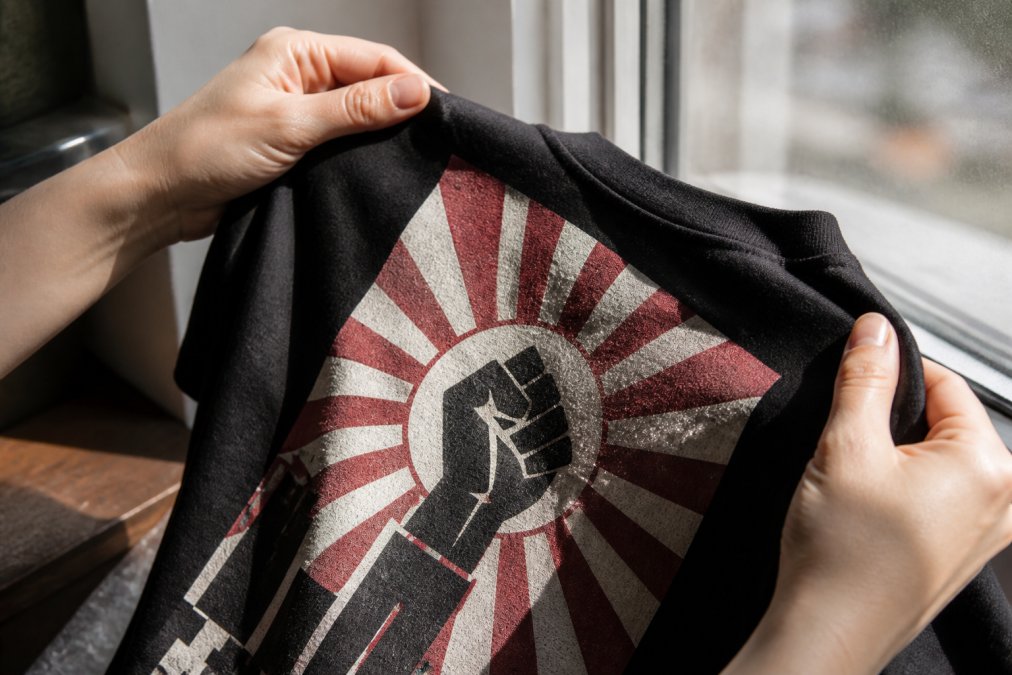
Print-on-Demand vs. Screen Printing Quality
Print-on-demand uses direct-to-garment printing, which sprays ink onto the shirt surface. It requires no setup cost, which is why small political shops rely on it.
Fabric Quality, Certifications, and Ethical Manufacturing
Certifications are the only reliable shortcut for verifying ethical manufacturing claims. A shirt can say "sweatshop-free" in the product copy; a certification means someone audited the supply chain.
The ones worth knowing:
- GOTS certified covers organic cotton from farm to finished garment, including social and environmental criteria.
- OEKO-TEX Standard 100 tests the finished textile for harmful substances, relevant if you have sensitive skin.
- WRAP-certified audits factories for lawful, humane, and ethical production conditions.
Sourcing Transparency Checklist
Use this before buying any activist tee. If a brand can't answer most of these, that's your answer.
- Does the listing name the fabric weight and fiber content?
- Is the cotton organic, and is that claim certified?
- Is the print method stated (screen print, DTG, or unspecified)?
- Does the brand name its manufacturing partners or region?
- Are there third-party labor certifications listed?
- Does the brand publish anything about ink type and disposal?
Durability, Shape Retention, and Garment Lifespan
Durability in a graphic tee is not one property but four failure modes.
How to Test a Tee Before You Commit to It
You don't need a lab to evaluate durability, a few physical checks tell you most of what you need:
- The stretch test: Grip the printed area and pull gently. A quality print flexes; a failing one separates along fold lines.
- The light test: Hold the shirt up to a window. If you can read a newspaper through the shoulder panel, the fabric is too light for hard wear.
- The seam check: Run a finger along the side seam and the shoulder seam. Flatlock or double-stitched seams resist blowouts; single-stitched seams do not.
- The twist check: Lay the shirt flat and see whether the side seams run straight down or curve toward the front. A curved seam means the panel was not cut on grain.
The Wash-Cycle Math
Most print and fabric failure happens in the dryer, not on your back. Three habits extend a tee's life:
- Wash cold, inside out, on a normal cycle
- Skip the dryer entirely or use the lowest heat setting
- Never iron directly over the print, use a pressing cloth or turn the shirt inside out
Ink Toxicity and End-of-Life Garment Disposal
A shirt's environmental story doesn't end when the print is cured, it continues through every wash and every decade in a landfill.
What Is Actually in the Ink
Screen printing inks fall into two broad families:
- Plastisol ink is a PVC-based suspension of pigment in a plasticizer. It cures by heating, not evaporating, which is why it sits on top of the fabric and feels like a rubber patch. Traditional plastisol can contain phthalates, which have drawn regulatory attention for health and environmental effects. Phthalate-free formulations exist and are increasingly common, but they are not the default.
- Water-based ink uses water as the carrier and soaks into the cotton fibers rather than sitting on top, producing a soft, matte finish with visible fabric texture underneath. It uses far fewer problematic compounds and is the lower-impact choice at every stage.
- Discharge ink is a water-based variant that removes the garment's dye rather than printing over it, producing an exceptionally soft print on dark fabrics. It works best on 100% cotton and is less predictable on blends.
A practical test: stretch the printed area under bright light. Water-based ink shows the fabric weave through the print; plastisol looks like a smooth, slightly glossy film.
Why End-of-Life Matters More Than Most Buyers Think
The Environmental Protection Agency's information on textile waste documents how much clothing ends up in municipal solid waste each year, and the number is not encouraging. For activist apparel specifically, the irony is sharp: a shirt made to carry a message about the planet is often the same shirt that ends up in a landfill within a few years.
End-of-life options, ranked roughly from best to worst:
- Cut-down reuse, cleaning rags, quilt patches, tote bags, keeps fabric in service longest and requires no industrial processing.
- Fiber-to-fiber recycling turns old cotton into new yarn, the gold standard for circularity, but print ink complicates it: plastisol residue is harder to separate from fiber than water-based ink, another reason water-based printing is better upstream.
- Textile recycling programs accept any condition, including stained and torn garments, but many downcycle the material into insulation or wiping cloths rather than new textiles.
- Donation works only for shirts still wearable. A cracked, faded protest tee is not a donation; it's a burden on the receiving organization.
The Sourcing Question to Ask
If a brand can't tell you what ink it prints with and what happens to its garments at end of life, it hasn't thought about the full lifecycle. That's a legitimate reason to look elsewhere, and the question that separates a brand selling activism as aesthetics from one that operates by the values it prints on the chest.
Conclusion
The hard part about buying politically charged clothing is that the message is loud and the manufacturing details are quiet. Fabric weight, print method, and construction determine whether the shirt is still wearable in three years.
Frequently Asked Questions
What GSM weight is considered high-quality for a graphic tee?
For graphic tees, 150-180 GSM (roughly 4.5-5.3 oz/yd²) is the sweet spot. This range gives you a soft feel with enough structure to hold a print without being heavy. Correct Geography's tees sit at 153 g/m² (4.5 oz/yd²), which keeps them lightweight and breathable while still durable enough for regular wear. Anything under 140 GSM tends to feel thin and may not hold up as well over time.
How can you tell if a graphic tee print will last through multiple washes?
Check the print method and ink type. Water-based inks and screen printing generally bond well to fabric, especially on cotton. Look for even ink coverage with no cracking or fading at the edges. Also check the care label: washing inside out in cold water and avoiding high heat in the dryer will extend print life. A print that feels slightly embedded into the fabric rather than sitting on top tends to last longer.
Are organic cotton tees more durable than standard cotton?
Organic cotton isn't automatically more durable, but it is grown without synthetic pesticides. Durability comes more from fiber length (long-staple cotton lasts longer), fabric weight, and construction details like double-stitched seams. A 153 g/m² organic or ring-spun cotton tee with reinforced neckline and shoulder taping will hold its shape better than a lighter, poorly constructed standard cotton shirt.
Why does fabric weight matter for activist apparel?
Fabric weight affects how a shirt drapes, how well it holds a print, and how long it lasts. Heavier fabrics (180+ GSM) feel more substantial and resist stretching, but can be less breathable. Lighter fabrics (150-160 GSM) are comfortable for everyday wear and layer well. For activist apparel worn at rallies, marches, or events, a mid-weight ring-spun cotton like 153 g/m² balances comfort, breathability, and durability so your message stays readable wash after wash.