
Table of Contents
- Why Original Place Names Still Matter in 2026
- How Wearing History Turns a T-Shirt Into a Conversation Starter
- Period Sources: Where Historical Accuracy Actually Comes From
- How to Style Historical Apparel Without Looking Like a Costume
- Where to Buy Historical Map Shirts Online (and What to Check First)
- Modern Etiquette for Wearing Politically Charged Historical Clothing
- Frequently Asked Questions
Last Updated: September 20, 2026
Why Original Place Names Still Matter in 2026
Place names carry centuries of memory, and wearing history to spark conversation starts with knowing what those names actually are. At Correct Geography, we build apparel around the idea that a name older than the country itself deserves better than a Sharpie edit. A name like the Gulf of Mexico has appeared on maps since 1552, roughly five centuries of continuous use. That kind of record does not get rewritten by a signature.

The stakes go beyond nostalgia. Names encode who lived somewhere first, what they called it, and why it stuck. When a label changes for political convenience rather than linguistic evolution, the map stops describing the place and starts describing the person holding the pen.
That is the tension this guide works through. Below, we cover how a printed t-shirt becomes a genuine conversation starter, where historical accuracy actually comes from, how to style period-inspired pieces without looking like a costume, what to check before buying online, and how to handle the etiquette of wearing politically charged clothing in public.
How Wearing History Turns a T-Shirt Into a Conversation Starter
A t-shirt with an old name on it works as a conversation starter because it invites a question instead of delivering a lecture. Someone reads "Since 1552," pauses, and asks why. That question is the whole point.
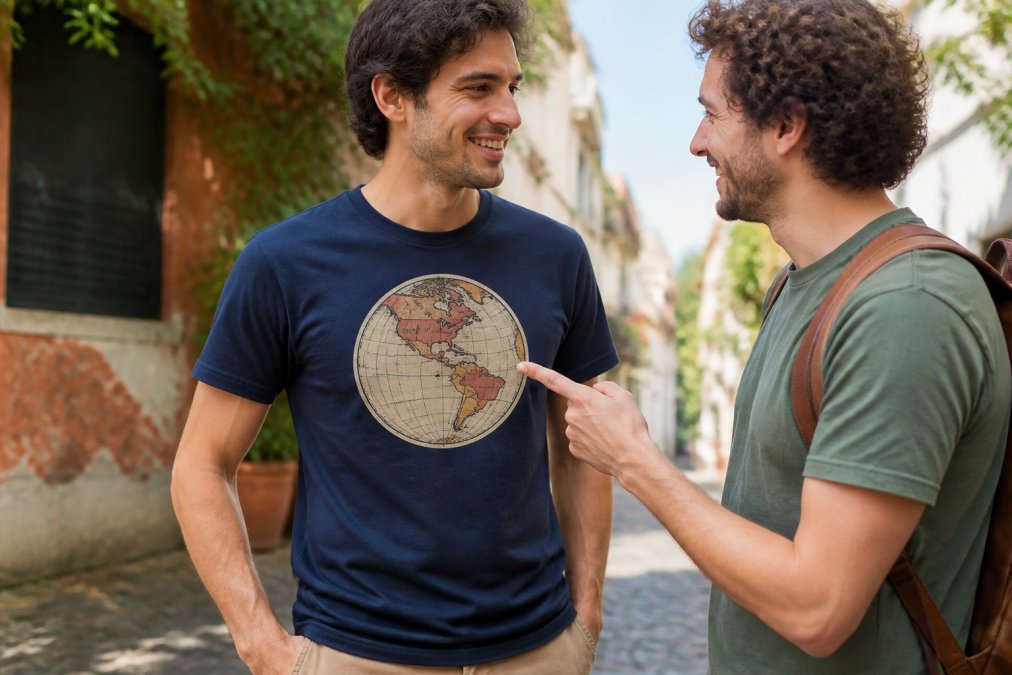
The best designs stay understated.
Period Sources: Where Historical Accuracy Actually Comes From
Historical accuracy comes from primary sources: maps, treaties, survey records, and published atlases from the period in question, not from a modern summary of them. A date printed on a shirt should be traceable to a document someone can actually open.
- Check the date against at least one digitized original map
- Confirm the spelling used at the time, not the modern spelling
- Look for a named archive or collection, not a vague "historically accurate" claim
- Read the fabric and construction specs before you buy
How to Style Historical Apparel Without Looking Like a Costume
The difference between historical apparel and a costume is restraint, and restraint is easier to hit when you understand why a piece reads as "period" in the first place. Costume happens when several signals stack: silhouette, fabric, print, and accessories all point the same direction at once. Break one or two of those signals and the same garment reads as a deliberate modern choice.
The four signals that tip a look into costume
- Silhouette. A boxy, high-hemmed, or dramatically oversized cut reads as period. A modern straight or slightly tapered fit reads as today.
- Fabric hand. Stiff, heavy, or shiny fabric signals costume. Soft, matte, ring-spun cotton signals everyday wear.
- Print style. Distressed, faded, or hand-lettered graphics read as vintage; clean modern type reads as contemporary. Pick one, not both.
- Accessories. Hats, suspenders, pocket watches, and period footwear multiply the effect. One period reference is a choice; three is a theme.
Fit matters more than most people expect. A shirt that is too tight or too oversized pulls attention to the fit instead of the message. A soft, lightweight ring-spun cotton tee with a little structure sits in the middle and looks intentional. In practice, a 4.5 oz/yd² ring-spun cotton tee with double-stitched necklines and shoulder-to-shoulder taping holds its shape through repeated washes, which keeps the silhouette modern instead of collapsing into a costume-y drape.
Outfit formulas that work
- Everyday: graphic tee + dark straight jeans + plain sneakers or boots.
- Layered: graphic tee under an open button-down or plain overshirt, sleeves rolled, graphic still visible.
- Cooler weather: graphic tee + plain crewneck or quarter-zip + chinos; keep the outer layer solid and unprinted.
- Smart-casual: graphic tee + unstructured blazer + plain trousers; the blazer reads modern and offsets the vintage print.
The psychological payoff
Most styling guides stop at "what to wear." The part they miss is why it works. Wearing a piece tied to a real historical record gives the wearer something concrete to stand on. That steadiness shows up in posture and in conversation: people who feel grounded in what they are wearing tend to speak about it more calmly and answer questions more directly.
Care and longevity
Historical-inspired pieces last longer when you treat them like the everyday garments they are. Wash cold, inside out, and tumble low or hang dry. Skip fabric softener, which coats the fibers and dulls print color. Turn the shirt inside out before washing to protect the graphic from abrasion against other garments. A shirt that survives fifty washes keeps starting conversations; one that fades in ten does not.
Where to Buy Historical Map Shirts Online (and What to Check First)
Buying historical map shirts online comes down to four checks: the accuracy of the claim, the fabric spec, the print method, and the return policy. Skip any one of them and you are guessing.
| Check | What to Look For | Why It Matters |
|---|---|---|
| Historical claim | A specific year or named source | Separates research from marketing |
| Fabric | Ring-spun cotton, stated weight | Predicts how it wears and washes |
| Construction | Double-stitched seams, taped shoulders | Determines how long it lasts |
| Print method | Printed to order, stated process | Affects color longevity |
Modern Etiquette for Wearing Politically Charged Historical Clothing
Politically charged clothing works best when you treat it as an invitation rather than a verdict. The wearer sets the tone, and the tone decides whether the conversation goes anywhere. Most guides stop there. What they miss is the practical layer: which settings call for which approach, what to actually say, and how to exit a conversation that turns hostile without escalating it.
Read the setting, not just the room
- Neighborhood cookout, farmers market, casual errands. Low stakes, high curiosity. This is where a historical graphic does its best work.
- Family events with mixed views. The shirt is not the problem; the timing is. Save it for a different day.
- Workplace with a dress code. A written policy settles it. If the code is silent, default to plain layers and keep the graphic for off-hours.
- Formal or ceremonial settings. A graphic tee is the wrong register regardless of message.
That is not censorship; it is picking your moment. Etiquette is about matching the garment to the context, not about muting the message.
What to actually say
When someone pushes back, answer the factual question and let the rest go. "It was called that before either of us were born" is a complete response. So is "It's on maps from the 1500s. I just think the older name is better." Both are short, both are checkable, and neither invites a fight.
A useful pattern is the three-beat answer:
- State the fact. One sentence, one date or source.
- State your position. One sentence, framed as a preference, not a verdict.
- Hand it back. Ask a question or change the subject. "Anyway, how's your week been?"
When to disengage
Not every conversation is worth having. If someone is looking for a fight rather than an answer, the etiquette move is to end it politely: "Fair enough. I'm not trying to change your mind today." Then walk away or change the subject. You do not owe anyone a debate because of what you are wearing.
The sustainability angle
There is a quieter reason to wear historical pieces that most etiquette guides ignore. Historical garments were built to be repaired, not replaced. Slow-fashion advocates point to the same principle today: fewer, better-made items, worn longer, mended when they wear. A shirt with double-stitched seams and taped shoulders is not just durable; it is the modern version of a pre-industrial idea that clothing should outlast a season.
The steadiness that makes it work
Wearing a piece tied to a real historical record gives the wearer something concrete to stand on, which tends to make public exchanges calmer rather than more heated. That steadiness is the point. The shirt is not the argument. It is the opening line, and the wearer supplies the rest.
Frequently Asked Questions
How does wearing historical clothing act as a conversation starter?
A shirt with an unfamiliar place name or an old date invites questions. When someone asks why your tee says 'Since 1552' or 'The Great One,' you get to explain the history behind it. That moment of curiosity is what turns wearing history into a conversation. The shirt does the opening line; you supply the context.
What should I check before I buy historical map shirts online?
Look for the source behind the name, not just the design. A good listing tells you why the place name matters and when it was used. Check the fabric specs too: ring-spun cotton at 4.5 oz/yd² with double-stitched seams holds up better than a cheap print.
How can I style historical apparel without it looking like a costume?
Treat the shirt as the statement and keep everything else quiet. Plain denim, neutral chinos, or a simple jacket let the printed name carry the outfit. Avoid pairing it with other vintage pieces at the same time. One historical reference per outfit reads as intentional; three reads as a reenactment.
Is wearing politically charged historical clothing appropriate in every setting?
Read the room. A shirt about the Gulf of Mexico or Denali works at a barbecue, a concert, or a casual office. It may not suit a formal workplace or a family event with strong opposing views. The point of wearing history is to start a conversation, not to ambush someone who cannot walk away.