
Last Updated: November 7, 2026
Quick Summary
Ancient place names are the names given to settlements, rivers, mountains and coasts before the names used today. Many were recorded by Greek and Roman writers and later reshaped by Latin, Old English and other languages, so modern names often preserve older roots.
- Roman names such as Londinium, Eboracum and Aquae Sulis were later reshaped into modern names like London, York and Bath.
- Latin platea became plaza in Spanish, place in French, piazza in Italian and praça in Portuguese.
- Old English elements such as burh, wic and ham still appear in many English place names today.
- Compare an etymology dictionary, an early map and a scholarly study to confirm a name's history.
Table of Contents
- 7 Ancient Names for Cities You Still Know Today
- Ancient Place Names and Modern Equivalents for Roman Sites
- Greek Influence on Ancient City Names Around the Mediterranean
- Medieval City Names and How Conquest Changed the Map
- Old English Place Names and the Roots Still Visible Today
- Non-Western Ancient Names and How to Pronounce Them
- Using Historical Names: Where to Start Your Own Research
- Frequently Asked Questions
Most American cities and landmarks carry names that were already old when the first colonists arrived, and many of them trace back to languages spoken thousands of years before English. Knowing what a place was called before it had its current name changes how you read a map. This guide walks through what ancient names for places were, how they changed, and how you can check the history yourself.
Ancient place names are the names given to settlements, rivers, mountains and coasts before the modern names used today. Most of them were recorded by Greek and Roman writers, medieval chroniclers or explorers, and many were later reshaped by the languages that followed.
7 Ancient Names for Cities You Still Know Today
Ancient names for places rarely vanished overnight. A name usually passed through several languages, each one shaping the sound and spelling a little more. The seven examples below show how far some of these names have travelled from their first form.
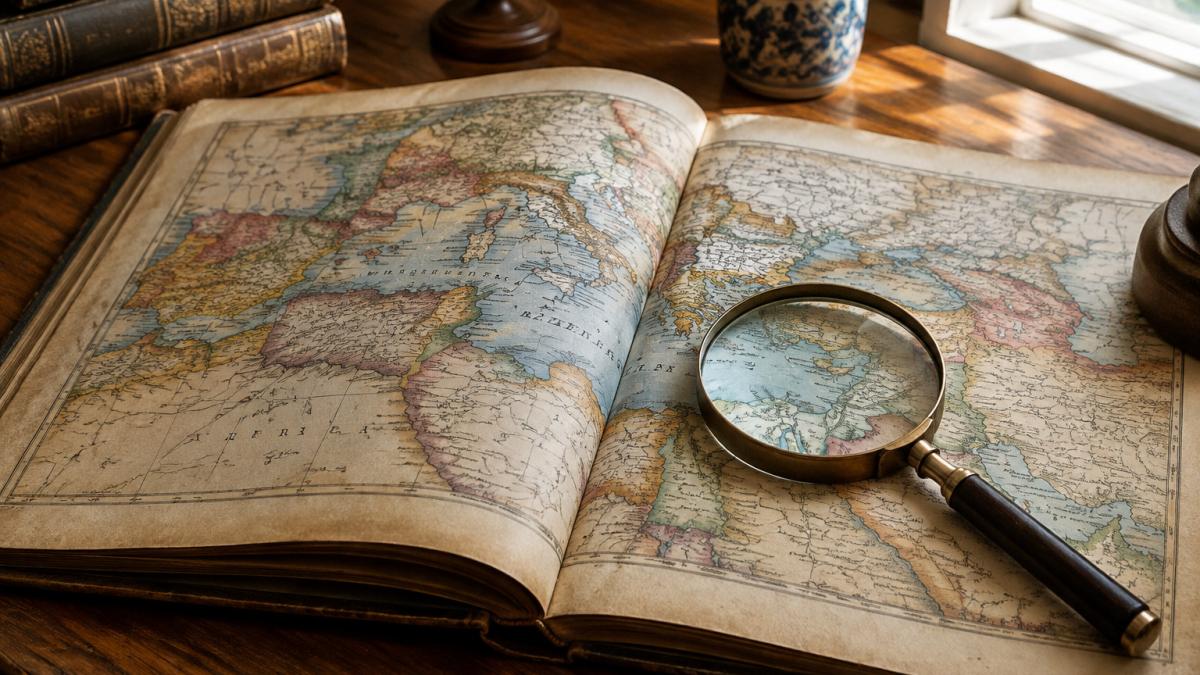
Quick Answer: Most modern place names are reshaped versions of older names, often through Latin, Greek or Old English. Tracing those roots shows how a place was described by the people who first named it.
Where the Names Came From: Etymology and Linguistic Roots
Etymology is the study of where words come from, and toponymy applies that study to place names. A toponym often records something visible about the land, such as a river, a hill, a harbor or a settlement's founder. Over time the original meaning can fade while the name itself survives in everyday speech.
Many names carry a prefix or suffix that signals their age and origin. Endings such as "-ford," "-ton" and "-by" point to Old English settlement patterns, while Latin and Greek endings mark names inherited from classical antiquity.
Ancient Place Names and Modern Equivalents for Roman Sites
Roman writers recorded many place names that still appear on modern maps, often with small changes in spelling. Roman military roads, forts and trading towns gave later settlements their names, and their Latinate forms are easy to spot once you know the pattern. The table below pairs some of the most recognizable Roman names with their modern equivalents, along with the Latin root that explains the connection.
| Roman name | Modern name | Latin root and meaning |
|---|---|---|
| Londinium | London | Possibly from a pre-Celtic root lond meaning "wild" or "bold" |
| Eboracum | York | From Celtic eburos "yew tree" |
| Aquae Sulis | Bath | Aquae "waters" + Sulis, a local goddess |
| Glevum | Gloucester | From Celtic glev "bright" or "shining" |
| Lindum Colonia | Lincoln | From Celtic lindo "pool" + Latin colonia "settlement" |
| Camulodunum | Colchester | From Camulos, a Celtic war god, + dunum "fort" |
| Deva | Chester | From Latin deva "goddess" or "holy" |
| Isca Dumnoniorum | Exeter | From Celtic isca "water" + Dumnonii tribal name |
| Venta Belgarum | Winchester | From Celtic venta "market" + Belgae tribe |
| Ratae Corieltauvorum | Leicester | From Celtic ratae "ramparts" + Corieltauvi tribe |
Historical maps and surviving itineraries, such as the Antonine Itinerary and the Peutinger Map, make it possible to match Roman names to modern equivalents. A careful reader can usually connect the two by comparing the location, the root word and the way the name was written in different centuries.
How Latin Names Shifted Across Europe
As Latin spread through Europe, local speakers adapted names to their own sounds. A single Latin root could produce several different modern forms depending on the language that inherited it. Spanish, French, Italian and Portuguese each reshaped the same roots in distinct ways. For example, the Latin platea "broad street" became plaza in Spanish, place in French, piazza in Italian and praça in Portuguese. The Latin forum "marketplace" survives as foro in Italian and Spanish, foire in French and feira in Portuguese.
The shift was rarely random. Common endings were softened or dropped, and vowels changed to suit local pronunciation. Recognizing these patterns helps you connect a modern name back to its Latin source. A common pattern is the loss of final -m in Latin names (e.g., Londinium to London), the softening of hard consonants before front vowels, and the substitution of local suffixes for Latin ones.
Watch out: Some Roman names were replaced entirely by later Germanic or Celtic names, so a modern town may sit on a Roman site without preserving the Roman name at all. Always check whether the modern name is a direct descendant or a later replacement.
Greek Influence on Ancient City Names Around the Mediterranean
Greek colonists founded many coastal towns around the Mediterranean, and they named them using words that described the site or honored a founder. Many of those names outlasted the Greek settlers themselves and were later adopted by Romans and then by modern speakers.
Greek naming habits often reflected geography. A harbor, a spring or a fertile plain might give a town its name, and the same descriptive logic appears in names far from the original Greek homeland.
Medieval City Names and How Conquest Changed the Map
Conquest, migration and trade all left marks on the map, and a single town could carry several names at once, each used by a different group of speakers.
Historians rely on charters, tax records and church documents to reconstruct these changes. Comparing medieval spellings with modern ones shows how names were simplified, translated or replaced entirely.
Old English Place Names and the Roots Still Visible Today
Many place names in England and the wider English-speaking world date back to Old English. Words such as "burh" for fortified settlement, "wic" for trading place and "ham" for homestead appear again and again in modern names.
Old English roots remain visible in place names that look ordinary today. Once you know the common elements, you can often guess the original meaning of a town, river or village name without consulting a dictionary.
Non-Western Ancient Names and How to Pronounce Them
Place names from Indigenous and other non-Western traditions often predate European contact by many centuries. Many were descriptive, referring to landscape features, seasons or local food sources, and they were passed down orally long before they appeared in writing. Most top-ranking articles focus on Europe and the Mediterranean, so this section claims a gap by covering non-Western naming systems and offering practical pronunciation guidance.
Ancient Names from Asia, Africa and the Americas
| Region | Ancient name | Modern name | Meaning and notes |
|---|---|---|---|
| China | Chang'an | Xi'an | "Perpetual peace"; capital of several dynasties |
| China | Peking | Beijing | "Northern capital"; spelling changed in the 20th century |
| India | Varanasi | Varanasi (Benares) | Named for the Varuna and Assi rivers |
| India | Bombay | Mumbai | From Mumbadevi, a local goddess |
| Japan | Edo | Tokyo | "Eastern capital"; renamed in 1868 |
| Egypt | Memphis | Mit Rahina | Named for the pyramid of Pepi I |
| Iraq | Babylon | Hillah (near) | From Akkadian babilu "gate of god" |
| Mexico | Tenochtitlan | Mexico City | Named for the Mexica people and a cactus |
| Peru | Cusco | Cusco | From Quechua qusqu "navel" or "center" |
| Turkey | Byzantium | Istanbul | From Greek Byzas, a founder; later Constantinople |
These examples show that non-Western naming systems often encoded geography, mythology or political power. In China, the suffix -jing means "capital" and appears in both Beijing and Nanjing. In the Andes, Quechua names frequently describe the shape of the land. In Mesoamerica, the Mexica named their capital after a vision of an eagle on a cactus, a story still depicted on the Mexican flag.
How to Pronounce Ancient Names
Pronunciation can be the hardest part. Many of these names use sounds that do not appear in English, and early written forms were often inconsistent. Listening to recordings made by speakers of the language, or consulting tribal and academic pronunciation guides, is the most reliable approach. The table below gives a simplified English-friendly pronunciation for each name above, using common respelling.
| Ancient name | Simplified pronunciation |
|---|---|
| Chang'an | chahng-AHN |
| Peking | pay-KING |
| Varanasi | vuh-RAH-nuh-see |
| Bombay | bom-BAY |
| Edo | EH-doh |
| Memphis | MEM-fiss |
| Babylon | BAB-uh-lon |
| Tenochtitlan | teh-noch-TEET-lahn |
| Cusco | KOOS-koh |
| Byzantium | bih-ZAN-tee-um |
For names with non-English sounds, such as the glottal stop in Tenochtitlan or the retroflex consonants in Varanasi, a simplified respelling is only an approximation. Academic resources such as the International Phonetic Alphabet (IPA) transcriptions in linguistic atlases can provide more precision.
Watch out: Early written forms of non-Western names were often recorded by outsiders who misheard or simplified sounds, so a spelling on a 16th-century map may not reflect how local speakers actually said the name. Cross-check with modern linguistic sources before treating any pronunciation as definitive.
Using Historical Names: Where to Start Your Own Research
Start with a modern map and a historical one of the same region. Look for names that changed, then trace each one back through old atlases, gazetteers and digitized maps held by university and national libraries.
For a structured approach, compare three sources for each name: an etymology dictionary, an early map and a scholarly study of the region's languages. When all three point the same direction, you can be fairly confident in the result.
Watch out: Early maps were often drawn by people who had never visited the place. A name printed on a 17th-century map may reflect a rumor or a copying error, so always check it against a second independent source before treating it as settled.
If you enjoy tracing place names, our Denali - The Great One Tee celebrates a mountain whose Alaska Native name has been in use for centuries. It is $25.00, printed to order, and made from 100% ring-spun cotton. Our Gulf of Mexico - Since 1552 Tee and Corrected Names Tee are also $25.00 each, so you can wear a piece of the history you just read about.
Frequently Asked Questions
What are some ancient city names?
Many well-known cities carried different names in antiquity. Byzantium became Constantinople and later Istanbul. Lutetia was the Roman name for Paris. Londinium was the Roman settlement that grew into London. Eboracum, the Roman name for York, shows how Latin names were adapted locally. Tracking these names shows how trade, conquest and language shaped the map over centuries, and most can be confirmed in surviving Roman itineraries and medieval chronicles.
What were some ancient Roman place names and their modern equivalents?
Roman names often survive in modified form. Colonia Agrippina became Cologne, Aquae Sulis is now Bath in England, and Mediolanum is Milan. Lugdunum is Lyon, and Burdigala is Bordeaux. Many of these names kept their Latin root while changing sound over time, so the modern version often reveals the original meaning when you compare spellings and regional pronunciations.
What are some medieval names for places?
Medieval names often blended Latin, Germanic and local languages. Constantinople was the medieval name for the capital that the Ottomans later called Istanbul. Aachen was known as Aquisgranum in Latin records. Many towns recorded in Domesday Book in 1086 appear there under Old English or Norman-influenced spellings. Medieval chronicles and charters are the best sources for these older forms.
What were some ancient names for places around the world?
Outside Europe, ancient names followed different conventions. Chang'an was the capital of several Chinese dynasties before the city became Xi'an. Tenochtitlan, the Mexica capital, now lies beneath Mexico City. Persepolis was the Achaemenid ceremonial center, known in Old Persian records by a different name. Non-Western naming often tied places to rulers, rivers or sacred sites, which is why the meanings can be as useful as the names themselves.
